
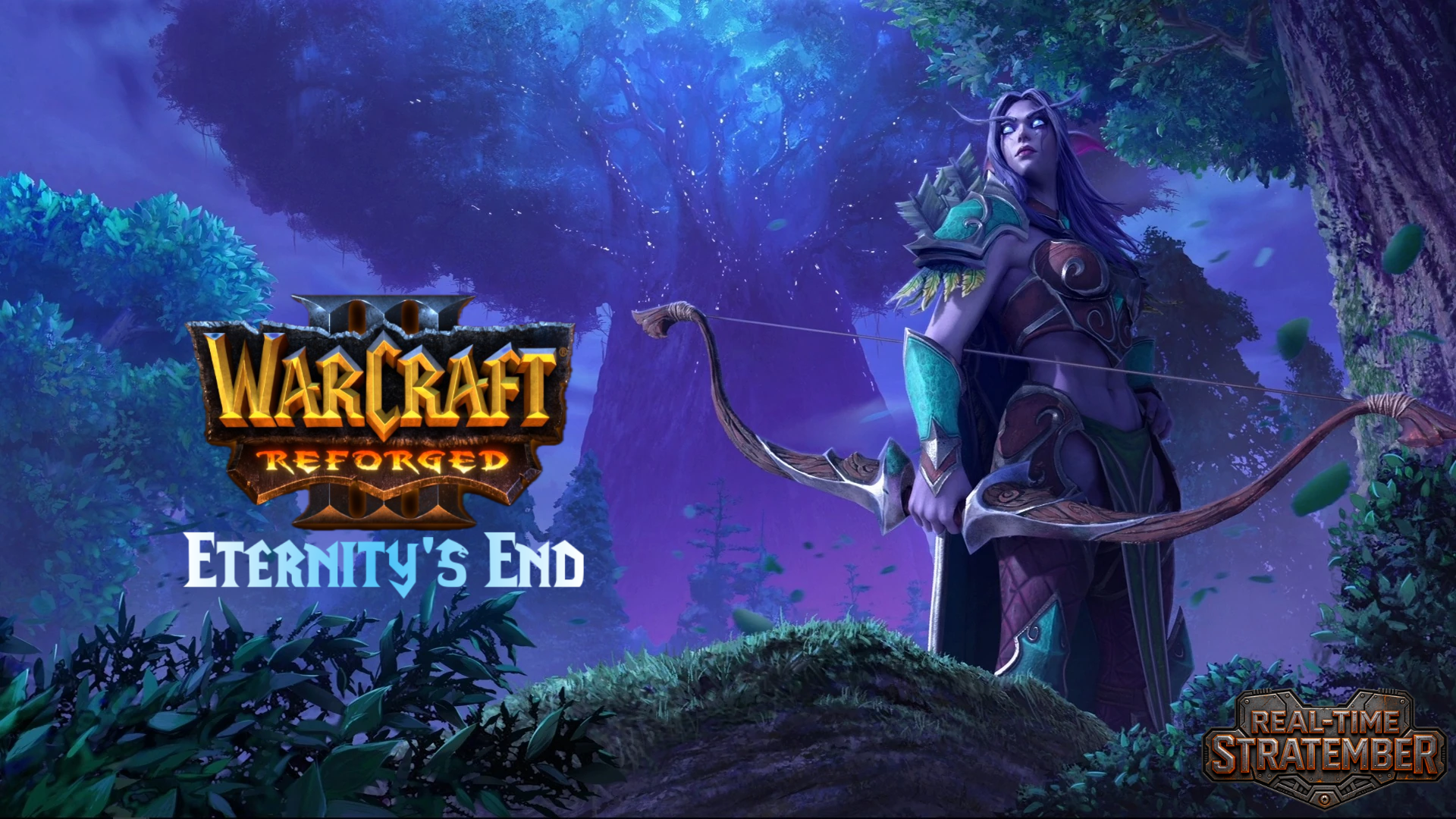
Warcraft 3 was a mainstay in our house for a ridiculous amount of time. Whether it was at LAN parties with friends with copious amounts of Cheeto dust, solo campaigning at home or firing up a leisurely skirmish on a quiet afternoon, Warcraft 3 was running hot. I played it with my brothers, my mates and logged countless hours in skirmishes against my Dad. Let’s just get this out of the way, because we all know it’s true: Warcraft 3 fuckin’ rules. It’s one of the best there is, the best there was and the best there ever will be. It’ll sit comfortably at the top of the list next to the likes of Command and Conquer: Red Alert 2. There was simply no way Real-Time Stratember was going ahead without including it, so I decided I’d tackle the campaign for my favourite race: The Night Elves. You’ll notice everything is a bit shinier, I went with Warcraft 3 Reforged for this one. Headed into this replay with zero research and armed with nothing but vague, twenty year old memories, I had Eternity’s End firmly pegged in my head as one of the single greatest campaigns in the entire game. Was that wrong? Should I not have done that? I still had a relatively good time jumping back in, but going in with nostalgia glasses firmly on might not have been the wisest choice.

The Night Elf campaign kinda felt like learning a completely different game in Warcraft 3 and that was one of the campaign’s big pulls. Warcraft had always been built on the familiar loop of cutting through forests and fortifying, but the Night Elves kinda flipped those RTS fundamentals on their head. It started with the worker units, the Wisps. Instead of chopping down trees like peons or peasants, Wisps just kinda phase into the forest and harvest lumber without destroying it. That subtle shift in itself fundamentally altered the layout of your base and your economy. The surrounding environment remains intact while giving you this ethereal, mobile worker unit that could even be sacrificed to strip enemy mana. The Night Elf buildings as well, all tree based, they clearly borrow from StarCraft with the Terran’s lift-off mechanic. You can uproot your sentient tree-buildings, march across the map and even join your army in battle before rooting back down to pump out units. This provided immense flexibility to what has historically been a fairly rigid base-building process. There’s also the overarching day/night cycle which managed to transform itself from simply atmospheric polish into a core Night Elf resource. Night recharges your Moon Wells to grant on-demand health regeneration and it also lets units use Shadowmeld to provide stealth or invisibility. Time itself makes itself available to you as a real, tangible resource. It almost makes the Night Elves feel more like a fluid, living organism.

The mechanics were truly a breath of fresh air and the story of Eternity’s End was the massive payoff where the Reign of Chaos story finally wrapped up. We’d spent the previous campaigns watching everyone tear each other apart. Humans and Orcs willfully dragging their grudges across the sea, Night Elves ambushing the Horde for cutting through Ashenvale’s forests, and so on. The mysterious Prophet finally shows his hand and reveals himself as Medivh, the Last Guardian. He forces Jaina, Thrall, Malfurion and Tyrande onto the same team and it’s a bit of a sobering NEWS TEAM, ASSEMBLE moment. A very harsh realisation that squabbling amongst themselves will mean literally nothing if Archimonde and the Burning Legion are to wipe them all out with their sheer apocalyptic power. They’re hopelessly outgunned on their own and clearly the best option is to team up. Still, the true catalyst wasn’t unity. It was Illidan Stormrage. Fresh off a ten thousand year prison sentence, Illidan makes the heads-up, wildcard (or bonehead?) play and consumes the demonic Skull of Gul’dan which permanently transforms him into a fel-scarred demon. It kinda alters Warcraft’s lore trajectory and injects a massive dose of early-00’s antihero edge. Was the choice selfish? Maybe. Was it morally grey? Absolutely. But consuming the skull gave Illidan the raw, unfettered power necessary to push the Legion back. I mean, it only cost him his soul and got him banished from the very homeland he just saved. Small price.

Then comes the pièce de résistance, the final mission: Twilight of the Gods. The Night Elf campaign has its issues, but this is an undeniably unreal finale. It’s one of the most stressful, legendary defense maps in real-time strategy history and the premise is both brilliant and brutal. Hold off the Burning Legion for forty-five rough, gruelling minutes. You’re no chance to defeat Archimonde in combat, dude is a freight train flanked by endless waves of overpowered, demonic bastards. The real tension comes from trying to manage a prolonged, controlled retreat. This starts with trying to fortify Jaina’s base, but endless waves of the Burning Legion will eventually consume it. Then, you fall back and try to dig in with Thrall and the Horde. Again, Archimonde and his goons steamroll over the Orcs while you try to buy time. Inevitably, the Legion make the final push up Mount Hyjal. When the Burning Legion reach the Night Elf base at the foot of the World Tree, you’re trying to micro-manage every unit, every Moon Well and push delay tactics until they’re coming out your ass. Once the timer finally hits zero, the pressure dissolves into pure spectacle. Nobody said Blizzard couldn’t do a good cutscene, eh. Malfurion Stormrage sounds the horn of Cenarius and thousands of wisps from the World Tree swarm Archimonde, simultaneously detonating in a blinding flash to vaporise him. It might cost the Night Elves their sacred immortality and tears Nordrassil to shreds, but it banishes the Burning Legion. Truly, a legendary end to one of the best real-time strategy games of all time.

If I were to rate Eternity’s End purely as a traditional real-time strategy campaign it’d probably hover somewhere around a seven. Maybe an eight, if I was feeling generous. Navigating the claustrophobic, tedious Barrow Deeps is a slog. It is. The overall campaign runtime feels surprisingly short even with a mandatory forty-five minute finale and some of the more delicate units require a lot more micro-managing than I’d like. Then, there’s the criminally low screen time for a massive franchise favourite and heavyweight like Illidan Stormrage. It feels like we just gain control of him, witness his demonic turn and we’re at the finale. But judging Eternity’s End purely on its structural woes kinda misses the bigger picture. What Blizzard pulled off here was a monumental shift in how stories could be told within strategy games. It reshaped how base-building can work (even if it stole it from its own product), it proved that you can turn the time of day into a legitimate tactical advantage and it established a powerful factional identity that kinda stepped outside the usual, expected early-00’s fantasy playbook. Between the somewhat, albeit short-lived, unhinged antihero evolution of Illidan and a Mount Hyjal showdown that still stresses me out just thinking about it, this wasn’t just a neat way to wrap up Reign of Chaos. This is an absolute banger of a finale that permanently elevated what Warcraft could be.
Verdict:
Warcraft 3 Rules.

Leave a Reply