
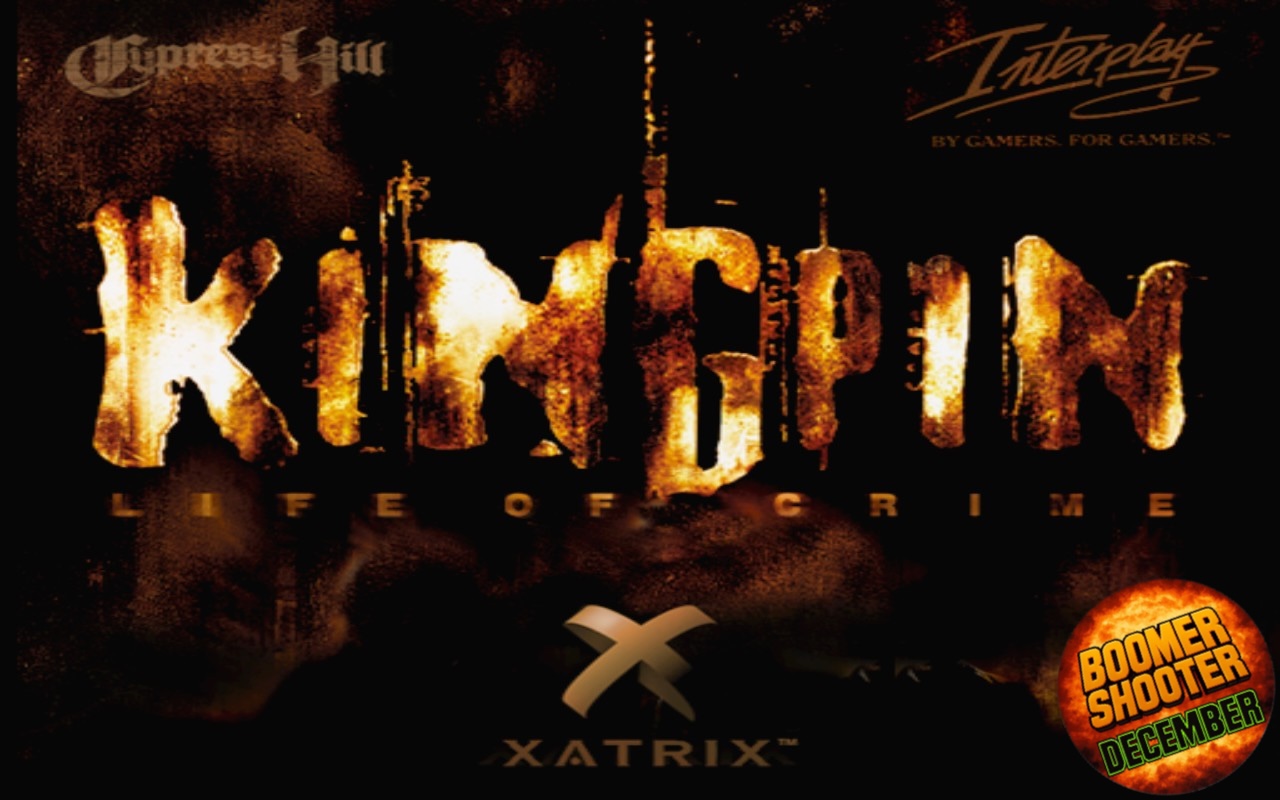
It might not the top dog when it comes to first-person shooters, but Kingpin: Life of Crime definitely got a good run in our house. Maybe it was Cypress Hill doing the soundtrack or the gratuitous amount of swearing, but for some reason this game stuck. I guess it was one of those games that maybe felt a little forbidden with every second word being some form of profanity. Our folks didn’t really care about the swearing, as long as we weren’t running around yelling “fuck you, fuck!” at each other. I probably didn’t even understand half of what was going on, but it didn’t really matter. I remember Kingpin being a fairly unique and fun first person shooter which had some extra features other games of the same era just didn’t have. That… and… yeah, the swearing was pretty badass.

Kingpin: Life of Crime was released in 1999 by Xatrix Entertainment and utilises the Quake 2 engine, which was a couple years old at the time of release. Honestly, Xatrix did a great job of morphing Quake 2 into a metropolitan gangster shooter. Kingpin even has a pretty decent story too, it’s not some cinema-level masterpiece but it’s decent enough for a late-’90s first-person shooter. You start in the grimy, gutter-level dystopia of Skidrow, waking up next to a dumpster after being worked over by Nikki Blanco’s goons. Nikki is a sleazy, incompetent mid-level enforcer and one of the Kingpin’s most trusted lieutenants. The Kingpin himself is the boss running crime operations across each area you visit, with a lieutenant in each district kicking their ill-gotten gains up the chain. It’s not really explained, at all, but Nikki wants you out of his neighbourhood and the beating you receive is supposed to be the “and stay out” message. Obviously, that message isn’t taken on board and you kick off a revenge tour to take Nikki down. Getting revenge on Nikki quickly grows into something bigger as you start climbing the criminal corporate ladder, until you end up in Radio City to go head-to-head with the Kingpin himself. At its core, this is a simple revenge story. And it totally works.

The gameplay isn’t exactly what you would expect out of the Quake 2 engine and I don’t mean that as a bad thing. Xatrix heavily modified the game engine with updated graphics and some surprisingly effective RPG-like elements. The changes make it less of a fast-paced reflex shooter and more like a rough ’90s prototype of what the shooter-RPG hybrid would eventually become. It’s not open-world, but you do get hub-like districts with side quests, a vendor in Pawn-O-Matic, recruitable goon NPCs, cash to collect and manage, and some limited dialogue options which gives us a pretty vague sense of choice. The game is linear, but it kinda feels like what you say or do might influence a situation. Pro tip: it doesn’t. The quest system is based around a simple notepad mechanic, talking to NPCs to get information in each hub area to figure out where to go and what to do next. It’s simple, but it works really well. The level design is also top-notch, there’s no feeling lost here. Kingpin ends up feeling like a scrappy ’90s precursor to the shooter-RPG hybrid trend of games that we saw emerge throughout the ’00s.

Kingpin oozes atmosphere. It has that gritty, grimy kinda rust-soaked look where it feels like every building could be just one bad day away from collapsing in on itself and it totally works. You’ve got alleys that look like they smell of piss and burnt motor oil, while every club you walk into feels like it’s lit by a single, dying light bulb. You become suspicious of every NPC, unsure whether they’re going to mug you or ask for a pack of Winnie Blues. That unapologetically filthy look forms a huge part of the game’s identity. The world feels alive in a sorta rough, hostile way and while it’s not pretty to look at, it perfectly suits what Kingpin is trying to be. The soundtrack plays into that incredibly well too. Cypress Hill provided the soundtrack for the game and it features three tracks from their 1998 album IV: 16 Men Till There’s No Men Left, Checkmate and Lightning Strikes. Instrumental versions of those tracks are used for backing music in different areas of the game. Cypress Hill also provided some of the voice acting. I really like the soundtrack, I do, but those instrumental loops get incredibly repetitive after you’ve run through a few areas. At times, I honestly would have preferred silence rather than the same track for the tenth time in a row.

Combat in Kingpin feels surprisingly… heavy? It definitely feels slow for something built on the Quake 2 engine and everything kinda hits with this grimy, industrial-style crunch. Firing the shotgun or the heavy machine gun really gives the illusion that these things are held together by bits of wire and duct tape. There’s a few weapon upgrades available too, you can grab those at the Pawn-O-Matic, which is basically your lifeline. It’s the only place to buy weapons, ammo, armour or upgrades. That’s assuming you haven’t blown all your cash on goons who then get caught in an elevator and crushed into a visceral cube. To say the NPC system is janky would be an understatement. It’s clever, but also manages to be unintentionally hilarious. You can recruit goons and give them commands like follow, stay and some have skills like safe-cracking or demolitions. In practice they end up blocking doorways, charging into firefights with no warning or don’t show up at all when you need them most. Outside of goons, you can talk to almost anyone with either a positive or negative response. Keep pushing a negative response and you’ll eventually say “I will fucking bury you” which triggers a fight. Iconic, really. The weapons, slow-burn shootouts and barely competent hired goons combine to form this weird, scrappy combat system that feels completely unique.

Playing Kingpin again after all these years has been a pretty satisfying experience. It’s still noticeably a little rough around the edges, but it establishes a compelling atmosphere, attitude and just seems to have this ambition that keeps it from fading into obscurity. Still, I’d avoid the remaster and use the fan patch instead for some quality of life. The RPG-style mechanics are absolutely janky, the hired goons are unreliable to the point that it’s actually just hilarious and the soundtrack loops will definitely test your patience. But even with its quirks, everything just kinda works anyway. Kingpin feels like a game that’s batting way above its average, but continues to knock them out of the park. If nothing else, it’s an interesting look back at those early shooter-RPG mechanics to see how far games have advanced. Honestly, I had a ton of fun with this one, it’s a filthy slice of ’90s PC gaming in more ways than one and it’s more than worth a look. It definitely earned its place in Boomer Shooter December.
Verdict:
Kingpin definitely shows its age, but its grime-soaked world and early shooter-RPG ambitions give it a distinct identity few first-person shooters from the era can match. Despite the jank and gratuitous swearing, it’s an engaging and thoroughly entertaining experience.
Deck Compatibility: 10/10
Overall Game Rating: 7.5/10 – Gritty ’90s Ambition
Steam Deck Specifics:
I went with the GOG release of Kingpin, installed via the offline installer with Lutris. Check out my guide if you’d like to go the same route. The controller won’t work out of the box, so you’ll need to manually map your controls or use a community layout. I’d also recommend enabling Gyro aiming, which is a genuine game-changer. I plan on writing a guide for Gyro after Boomer Shooter December wraps up.


Leave a Reply