
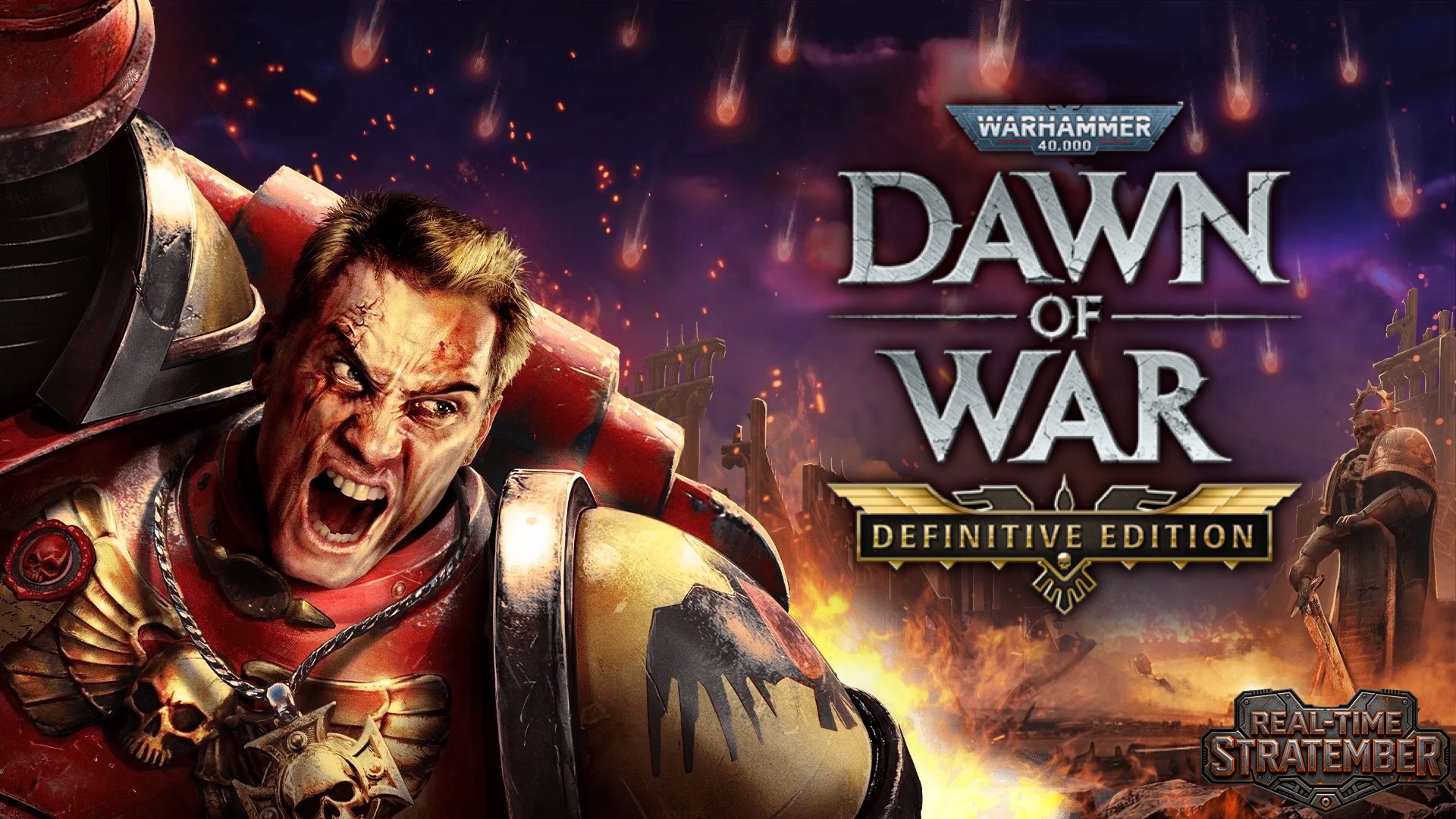
When Dawn of War released I actually had no freakin’ clue what Warhammer was, let alone Warhammer 40K. That didn’t stop me from playing the shit out of it. I still don’t really know that much about Warhammer, I’m pretty sure I’d really like it if I looked into it further. All I remember back then was when my brother came home with a dodgy copy of Dawn of War burned onto three equally dodgily marked CD-Rs, I was pretty well hooked. I remember practically none of the original campaign, except Captain Gabriel saying “walk softly… and carry a big gun”. What I do remember is way back in high school, when I set up a LAN party in my shed with a couple mates. Crammed in next to assorted garden tools was a beat to hell network switch, a tangled web of ethernet cables, beige computer cases and big ol’ CRT monitors. None of them had any idea how to play, so I tried to explain but I clearly explained… poorly. Yeah, you know how it ended. I tore them all to absolute shreds. Anyway, time to get stuck into one of my favourites from the mid-’00s only slightly updated with the Definitive Edition.

Warhammer 40K: Dawn of War was released by Relic Entertainment in 2004, with the Definitive Edition arriving in 2025. Dawn of War follows Captain Gabriel Angelos and the Blood Ravens Space Marines as they arrive on the planet Tartarus to put a stop to what appears to be a straightforward Ork invasion. The whole thing is a front for a more sinister plot engineered by Chaos sorcerer, Sindri Myr. Imperial Inquisitor Mordecai Toth arrives on Tartarus and orders Gabriel to evacuate as an incoming Warp Storm threatens to consume the planet and cut them off entirely. Gabriel refuses, he’s convinced that there’s something bigger going on. Dude is on the money, Eldar forces are also on Tartarus hunting an ancient Chaos artifact called the Maledictum. Meanwhile, Gabriel’s long-time friend and Space Marines Librarian, Isador Akios is revealed to have been secretly corrupted by Chaos and agrees to steal the Maledictum for Sindri Myr. Of course, things go wrong. After a brutal duel Gabriel kills Isador and together with Inquisitor Toth, they track Sindri to a ritual site but fail to apprehend him. Instead, Sindri sacrifices himself in a ritual with the Maledictum to summon a Daemon Prince. After the battle, Gabriel destroys the Maledictum with Toth’s Daemon Hammer. Unknowingly, Gabriel has just opened the Daemon’s prison and it reveals that the entire planet is a sacrificial altar with every death acting as an offering to allow the Daemon’s release. The Daemon allows the Blood Ravens to leave, with the Daemon and Gabriel hinting that the job isn’t done yet.

Dawn of War’s story is slow to start and clearly relies on its second half to keep it interesting. While the story ends up pretty solid, the mechanics are the real big draw. Relic’s take on real time-strategy feels both familiar and fresh, blending elements of both Blizzard and Westwood’s approach into something distinctly its own. Base building clearly takes influence from Blizzard’s usual formula with a builder unit and a mix of standard and advanced structures. Resources take a more Westwood approach with two resources to manage, Requisition and Power. Requisition comes from capturing strategic points with infantry and building listening posts on them with upgrades boosting them further. Power comes from building plasma generators or the much more expensive thermoplasma generators which can only be built on Slag Deposits scattered across the map, usually somewhere highly contested. Space Marine units all feel fairly standard, but heavier units dropping in via orbital deployment straight onto the battlefield never gets old. The real standout is the squad system. Each Space Marine squad starts at four units but this is upgradable to eight plus a sergeant, with four squad members able to upgrade to heavier weapons. The squad morale system also provides the potential to sink a squad entirely if it breaks, but the ability to reinforce on the fly means you won’t have to trek all the way back from your base. Some gnarly cover mechanics throughout the map keep combat legitimately interesting and somewhat tactical. Separate unit caps for both infantry and vehicles also keep things from spiraling into complete chaos.

Dawn of War left a pretty massive footprint on the real-time strategy genre. Back when everyone else was chopping wood or hoarding gold, Relic moved in a different direction and tried to reshape the formula. Tying the economy to controlling strategic points forces the player out of the comfort of their base and directly into aggressive, small-scale pockets of squad combat. Bold move. It’s hard to shake that typical economy-first mindset you come to expect from this era, but I think this is a move that absolutely paid off. Dawn of War’s influence is clearly felt in its direct descendant, Company of Heroes. Relic took those gnarly cover mechanics and squad-based combat introduced here and thoroughly spit-shined them into what is widely considered one of the greatest strategy games ever made. Nice to see legitimately good mechanics not going to waste. Dawn of War was a pretty big success itself, spawning three significant expansions in Winter Assault, Dark Crusade and Soulstorm. The expansions kept pumping the game full of new factions and new ways to play. I touched on it earlier, but my Warhammer knowledge is essentially patchy to non-existent. But if you believe the other retrospectives out there, and Relic’s own likely biased devs, Dawn of War is hailed as the definitive way to experience the Warhammer 40K universe in video game form. It captures the splattery absurdity of the tabletop game so well that even a clueless kid throwing a LAN party in a shed next to the lawnmower can feel how perfectly grim it was.

Dawn of War is still unreal two decades later and it’s easy to see why I played the everliving shit out of it. It isn’t just a bloody vehicle for a pretty grim story about the Space Marines’ downfall by having their heads rammed firmly up their own asses. It definitely delivers on that front, once the campaign finally finds its footing. But what really cements Dawn of War’s legacy in real-time strategy history is how Relic fearlessly throws out the already well established rulebook. By stripping away the usual resource loop and forcing you out of your base to fight for basically every single patch of dirt, they managed to reshape the RTS landscape with some desperate, chaotic energy that feels fresh and helps to define its own identity. It bridges the gap between that classic turtle-friendly base building and modern tactical combat and paved the way for the absolute bangers that followed. If you’re like me and still don’t have any clue about Warhammer or 40K, know that the sheer joy of dropping in a squad of Terminators from orbit to completely take over a firefight remains pretty well unmatched. Warhammer 40K: Dawn of War remains a clear mid-’00s classic and 2025’s Definitive Edition helps it remain relevant. I guess sometimes the best strategy truly is to walk softly and carry a big gun.
Verdict:
Warhammer 40K: Dawn of War attempts to rewrite the RTS rulebook by ditching the resource grind in favour of aggressive, chaotic squad-based combat and it pays off incredibly well. The strategic point system helps to bridge the gap between old school classics and modern bangers by encouraging you to get out of your base and into combat to increase resources. You also don’t need to be well versed in Warhammer lore to find joy in dropping a heavy squad of Terminators right onto a contested strategic point. Dawn of War remains an absolute classic and despite a slow start to the story, it’s one of my all-time favourites in the genre.
Deck Compatibility: 10/10
Overall Game Rating: 9/10 – For The Emperor

Leave a Reply