
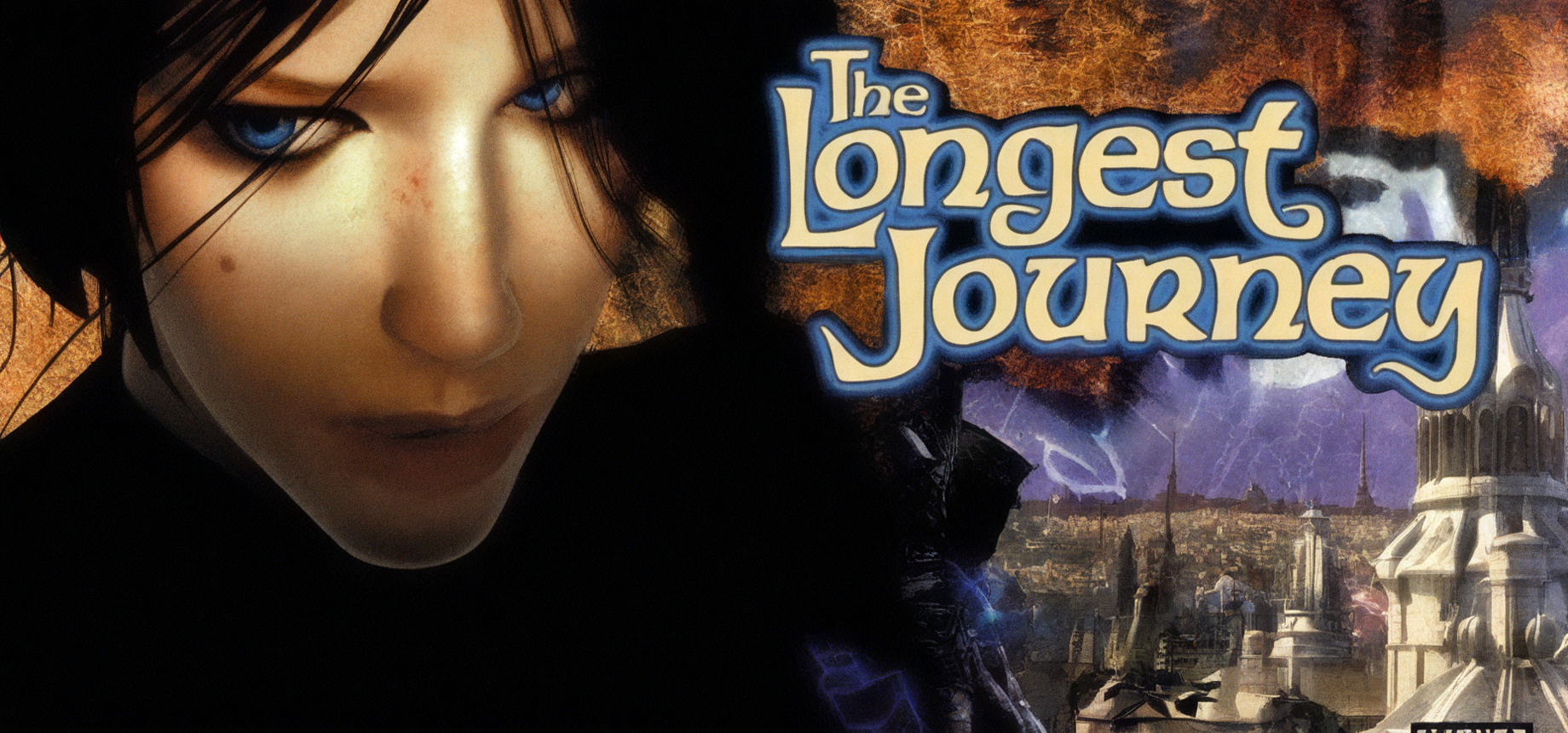
The Longest Journey has been sitting on my list for longer than I care to admit. In the late ’90s, early ’00s and even today, I’ve always heard it described as one of the best point and click adventure games ever made, if not THE best. We actually rented it from a local rental shop when it first came out and I remember being impressed by the graphics, but that’s about where my memories of it end. Like plenty of other games from that era, I put it off and never got back to it. As is tradition. I recently picked it up in the Steam Summer Sale and at about four bucks, it gave me the perfect excuse to finally see what all the fuss was about and to see if it lived up to the stellar reputation it carried. I like to think I’ve earned the right to have an opinion on it. Point and click adventures have been one of my favourite genres for years and I’ve played everything from LucasArts classics to Sierra’s best, along with plenty of forgotten bangers in between. You can even check out my personal top ten classic adventure games if you need proof that I’m not completely full of shit. I went into The Longest Journey expecting the masterpiece it’s always been hailed as. Instead, I found a game with some great ideas that rarely lives up to them.

I tried. I really did. But the puzzles in The Longest Journey have a reputation and not in a good way. The game seems to mistake obscurity for difficulty and the infamous rubber ducky puzzle is a perfect example. The full chain of events required to retrieve a key from the subway track involves the following: bread, a seagull, April’s gold ring as an electrical conductor, a clamp, a clothesline and a conveniently self-healing rubber ducky flotation device. A lot of it requires backtracking to areas you’d reasonably assume had been bled dry. It’s not difficult because it demands the kind of lateral thinking great adventure games are known for. It’s difficult because no reasonable chain of logic connects any of those steps. The underwater crystal alter later in the game is arguably even worse. It’s a symbol matching puzzle that many players suspect shipped with two positions accidentally swapped, meaning the solution is actually just pure trial and error. What makes it sting more than your average out-there adventure game is that these moments don’t exist to enrich the world or challenge your understanding of the story. They feel like filler designed entirely to put time between you and the next cutscene, almost like these arbitrary obstacles were designed by a completely different team than the one writing the damn thing.

I’m definitely not opposed to an interactive story, but what made LucasArts dialogue work so well at their peak is that it pulled its weight. You talked to a character to gather information you’d need later, unlock access to an area or to set a puzzle in motion. Every conversation had a purpose. The Longest Journey has its biggest swing and miss when it mistook volume for depth. I sat through a near ten minute conversation with April’s landlady that yielded nothing I could actually use, nothing that moved the story forward and nothing that made the world more interesting. That’s uh, not world building… That’s poor writing disguised as dense dialogue. That pacing problem continues throughout the game as the ratio of story momentum to dialogue becomes so unbalanced to the point where you’re essentially watching an interactive book that isn’t sure it actually wants to be interactive. The story’s tension plummets in real time because the game feels the need to pump the brakes to let a bit character monologue at length. Once the moment passes, you’re backtracking through areas you’ve long cleared. The writing unfortunately isn’t strong or consistent enough to really earn those pauses. When it is, it briefly becomes that top tier game people remember. When it isn’t, which is more often than not, it’s just a pretty rough, slow burn.

The Longest Journey deserves some credit for aiming higher than most adventure games of its era. The idea of two parallel worlds split between science and magic is legitimately compelling and there’s enough lore here to fill a novel, or at least novella. The problem is that the game seems far more interested in telling you about its universe than making you want to explore it. Conversations stretch on well after the point has been made, entire sections of the game feel like lore dumps and the pacing ends up buckling under the weight of its own ambition. The same can be said for the technology driving it. The early 3D engine makes navigation pretty awkward, the oversized environments create fairly unnecessary travel time and the mash-up of static backgrounds with clunky character movement serve as a constant reminder of the game’s limitations. The lack of clear hotspots are also a notable omission. I can’t help thinking that The Longest Journey’s reputation owes a lot to the state of adventure games in 1999 rather than the game itself. Outside of standouts like Grim Fandango, Discworld Noir, The Curse of Monkey Island, Broken Sword II and Sanitarium the genre was clearly in decline with very few games pushing it forward. There’s an abundance of ideas here, but ideas alone don’t make a masterpiece. Great concepts need great execution and that’s where The Longest Journey falls short.

I can appreciate why The Longest Journey still has such a passionate fanbase. The ambition here is undeniable. The world was unlike anything else at the time and it clearly influenced plenty of adventure games that followed. But influence and quality aren’t the same thing. Looking back with mostly fresh eyes, I don’t see the masterpiece I’d always heard about for the last twenty-seven years. I see a game buried beneath frustrating, nonsensical puzzles with painfully slow pacing and an obsession with telling instead of showing. I think there’s a great adventure game buried within it… somewhere. But it’s smothered by poor design decisions that constantly get in the way. If you’ve got nostalgia for it, I get it and I can understand why you’d defend it. If you’re coming into it for the first time, temper those expectations. Temper them well and good. The Longest Journey is a game that’s far more enjoyable to remember than it is to actually play. Sometimes a legendary reputation says just as much about the particular era a game came from as it does about the game itself. Some journeys are worth taking no matter how long they are. Unfortunately, this wasn’t one of them.

Leave a Reply