
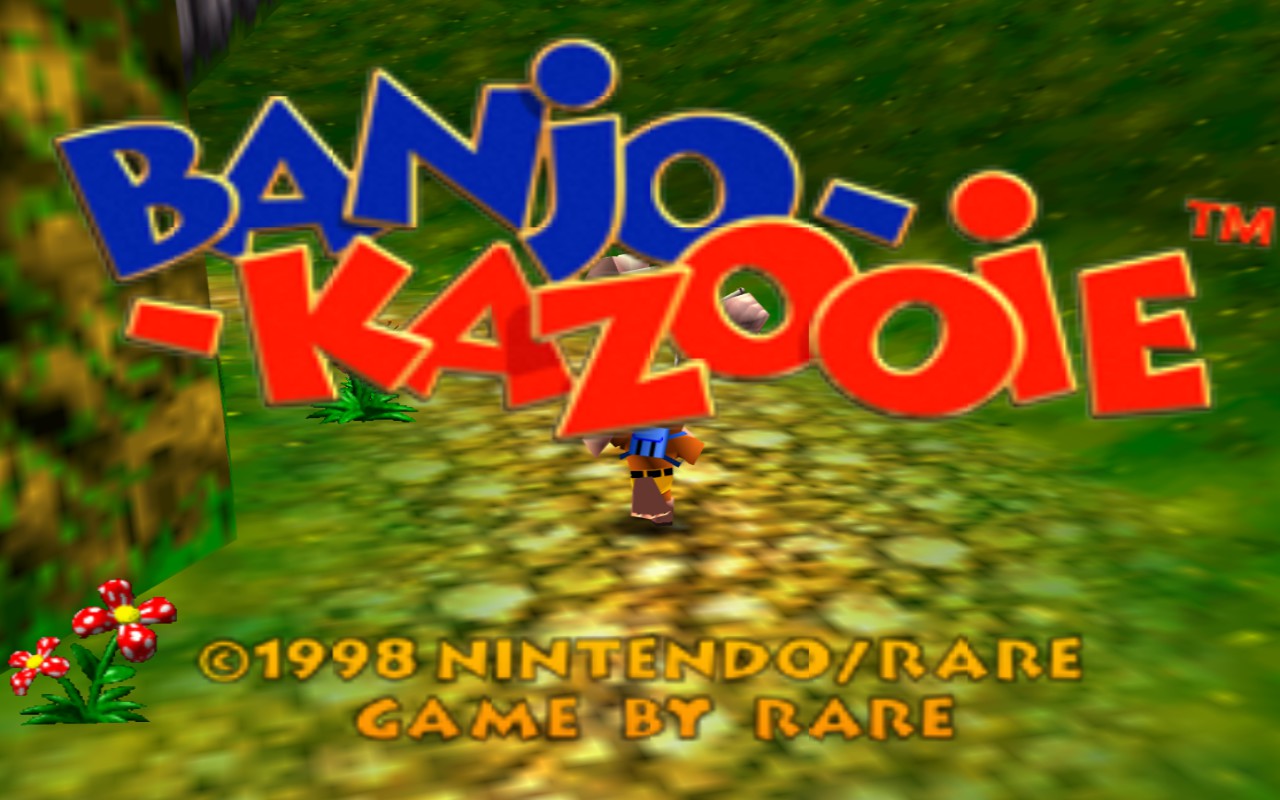
I didn’t own a Nintendo 64 growing up, my family had the original PlayStation. Sorry Nintendo fans, it was the better console. Sony didn’t win the battle in terms of raw power, Nintendo had them beat in that category. But it was the PlayStation which was more developer friendly and it’s CD format allowed for better audio, more content and stronger third-party support. The humble cartridge still put up a good fight, with Nintendo managing to crank out some genuinely top tier titles which still hold up even decades later. I’ve owned a few Nintendo 64 consoles over the years, but my experience with these games came long after their original release date. I guess I’m approaching these games without the nostalgia goggles on, which gives me a slightly more objective point of view. I didn’t play Banjo-Kazooie at launch, or even anywhere close to launch. If I remember rightly, it was around 2008 or 2009 that I first owned it and played it. Even then, it would have been for about an hour at best. It wasn’t until years later that I had proper exposure to it when my then-fiancée pulled her old Nintendo 64 out of storage, hooked it up in the living room to finally beat Banjo-Kazooie. It didn’t happen, she was pretty close but it ultimately landed back on the shelf. Now, years later in 2025, I’ve decided it’s finally time to see if it lives up to the hype. My now-wife suggested that I wouldn’t finish it. Not that I couldn’t finish it, that I wouldn’t finish it. To channel Barney Stinson, yet again, challenge accepted!

Banjo-Kazooie was released by Rare in 1998 for the Nintendo 64. It’s a 3D platform game clearly inspired by Super Mario 64, following a similar format with a hub-world structure, collectible-driven progression and overall game feel. You control two characters rolled into a single playable package. Banjo, a friendly and laid-back honey bear and Kazooie, a fairly aggressive bird who lives in Banjo’s backpack and doesn’t shy away from shit-stirring. Both have a very particular set of skills. Skills they have acquired over many levels and a robust tutorial. Bottles the mole reveals our new skills as you progress through each level. We also have Mumbo Jumbo, a skull-faced shaman, who shows up in very convenient locations to assist our heroes, he can transform our dynamic duo into other creatures with varying abilities. The story is quite simple, the evil witch Gruntilda kidnaps Banjo’s sister, Tooty, in an attempt to steal her beauty for herself. Banjo and Kazooie make their way through Gruntilda’s lair collecting musical notes and puzzle pieces, or jiggies, to unlock new areas to eventually progress to a final showdown with Gruntilda and rescue Tooty. From the outset, it’s clear Banjo-Kazooie draws a lot of influence from Super Mario 64. We have Gruntilda’s Lair in place of Peach’s Castle, musical notes and jiggies in place of stars. That influence, while undeniable, doesn’t mean this is a carbon copy. Banjo-Kazooie manages to build it’s own distinct personality with it’s fun abilities, quirky cast of characters and trademark Rare humour.

While I own and have played the game on original hardware, playing Banjo-Kazooie without an original Nintendo 64 controller is actually a breath of fresh air. The addition of save states is also a total revelation and that alone cuts out a great deal of frustration and controller smashing that comes with the original hardware. Not to mention the probably 6 hours or more of game time saved not re-climbing that freakin’ tree in Click-Clock Wood. Clearly the game does suffer as time goes on with outdated mechanics, which is to be expected when playing a game that is nearly 30 years old. To be honest most abilities are pretty manageable, but you may still miss a beat. When it comes to swimming, be very prepared to have your blood boil at the slightest inconvenience. I found swimming to be the worst implemented form of movement in the game. You might think you’ve lined up a note perfectly only to overshoot it by a lot, then circle back only to miss it again is even more fuel to the fire. It may have something to do with up and down being inverted, but even if it wasn’t I would anticipate still having a bad time. Timing is everything with any of Banjo or Kazooie’s abilities but the real lasting uphill battle is against the game camera. I can confidently say Banjo-Kazooie holds the crown for the undisputed worst in-game camera of any video game I have ever played. You could be lining up a jump across a ledge or turning a corner and the camera decides to take a sharp detour away from anything that resembles a helpful angle and instead gives you a mindful closeup of a wall as you fall to your death. These issues are further amplified when swimming or aiming to shoot eggs. Particularly shooting eggs in the final battle against Gruntilda.

It’s really no secret that Banjo-Kazooie leans HARD into the cuteness factor and in all honesty, I doubt that it would be even half as successful without it. A big part of the game’s charm comes from how thoroughly it embraces that aesthetic. Each world is packed full of cheerful sounds, quirky animations and a cast of characters and critters designed to endear themselves to the player almost immediately. The Jinjos are an obvious standout for me. Small, goofy, brightly coloured rodent-like things that yell “help” in a squeaky voice when you’re nearby. Banjo himself, a clothed honey bear with a little backpack is about as textbook ‘adorable mascot’ as it gets. While there are many others, one critter that I’ll point out is Leaky, the friendly sentient water bucket from Treasure Trove Cove with big googly eyes. I’ve always been a sucker for inanimate objects with added eyeballs, so a clear well-played to Rare for that one. Even the caterpillars in Click-Clock Wood are basically just green tubes with oversized cartoon eyes, and yet they still manage to feel right at home in the wider cast of cutesy oddballs. Speaking of Click-Clock Wood, the bee transformation courtesy of our friend Mumbo Jumbo might just be the peak. A plump, buzzing bee with narrow wings that don’t fill you with confidence and of course Banjo’s little backpack. It’s pretty ridiculous in the best way possible and easily my favourite of all the game’s transformations. My personal favourites aside, the cuteness factor isn’t just surface dressing. It’s baked into the design language of each and every area, world and encounter giving the game a playful and inviting personality that makes even the more difficult moments feel approachable and fun.

Ultimately, Banjo-Kazooie lives up to the hype. While I have some issues with the game camera and timing of certain abilities, neither really take away from the game itself. Back in 1998 Rare delivered a fun, enjoyable and rewarding 3D platform game which features a fair progression system and a flair for cuteness. There are a few frustrations along the way but c’mon now, it just wouldn’t be a platformer if it didn’t have its fair share of frustrations. Even with its flaws the game still well and truly holds up today. Each world feels like it has been crafted to be genuinely unique and each features mostly fun puzzles which won’t have you stuck for lengthy periods of time contemplating your own existence. The small capacity of an Nintendo 64 cartridge aside, the sound design and music are nothing short of iconic. This is a textbook example of a top tier Nintendo 64 title. The way the sounds and music perfectly blend together with each world creates an atmosphere and experience that’s both fun and memorable. The music from Mumbo’s Mountain continues to live rent free in my head. The control scheme is straightforward and fairly intuitive, allowing players of any skill level to quickly get comfortable and start enjoying the game within a few minutes of play time. The story, while simple, is more than enough for you to buy in and want to defeat that evil witch. Banjo-Kazooie is not just a standout from the Nintendo 64 era, but it is a classic platformer that still earns it’s place today.
Verdict:
Banjo-Kazooie remains a distinct and memorable 3D platformer, even if it is held back at times by a frustrating camera and some outdated mechanics. Rare delivered a clearly cute, fun and unique world full of engaging puzzles, iconic music and fairly intuitive controls. Finally getting around to it years after its release, the game holds up as a classic Rare title that really captures the spirit of the Nintendo 64 era while providing a thoroughly enjoyable experience for both longtime fans and first-time players.
Deck Compatibility: 10/10
Overall Game Rating: 8/10 – An Iconic Platformer
Leave a Reply